


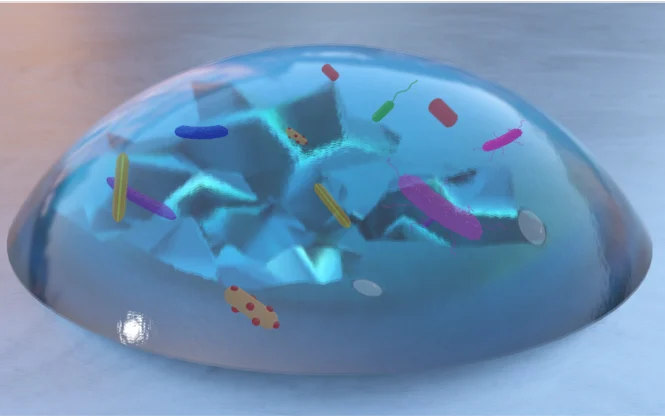
Initial bacterial retention on polydimethylsiloxane of various stiffnesses: The relevance of modulus (mis)match
Viktoriia Drebezghova et al. Colloids and Surfaces B: Biointerfaces, 2022, 217, pp.112709. ⟨10.1016/j.colsurfb.2022.112709⟩
We studied the initial retention of the bacterium Escherichia coli on model poly(dimethylsiloxane) (PDMS) surfaces was studied as a function of substrate bulk and surface mechanical stiffness values. Our reference PDMS system was designed such that out of the parameters that govern bacterial adhesion only the mechanical stiffness was systematically varied. This was achieved by varying the crosslinking density of PDMS. Following crosslinking, we performed Soxhlet extraction of non-crosslinked, free chains to rule out their effect on bacterial response. We observed a decreasing trend with the increase of both bulk and surface mechanical stiffnesses down to a limit corresponding to the Young’s modulus of the bacterial cell surface. For higher values than this threshold, the number of retained bacteria remained constant. We tentatively explain this observation by considering conformal overlay of bacterial and material surfaces.